
How Do SARMs Work? How They Target Muscle and Bone
How do SARMs work? They bind to androgen receptors in your body. They do it selectively, affecting only specific tissues (muscle and bone). In this article, we explore this topic more deeply – read on to find out more!
Last Update: 11.08.2026
Questions answered in this article:
- How do SARMs work?
- Do different SARMs work differently?
New to SARMs? Read our beginner’s guide on what SARMs are.
Looking for the complete reference? See our main guide: The CORE SARMs Handbook — Compounds, Cycles & Recovery, Explained. There you’ll find this compound alongside every other popular SARM, with full profiles, stacking guides, cycle protocols, and post‑cycle support advice all in one place.
How Do SARMs Work?
Selective androgen receptor modulators (SARMs) bind to selected androgen receptors in your body with anabolic, but little androgenic activity.[1] The word selective is key in this case.
On the surface, SARMs work like anabolic and androgenic steroids. The main difference is that, unlike these two, they do not broadly interact with androgen receptors. Instead, they target specifically the receptors in muscle and bone tissues. As a result, they may provide the same or even improved benefits, without the same amount of side effects (though this does not mean they are side-effect-free).
Are SARMs Precisely Effective?
No, SARMs aren’t precisely effective. While they are generally considered to have a more targeted mechanism, they may still interact with other tissues to some extent, and their effects can vary depending on the compound, dosage, and individual response.
Do Different SARMs Work Differently?
The mechanism for different SARMs remains the same – they bind to the same receptors. However, they differ in the type of binding and their own chemical structure, which impacts the end effect. [2]
You can see this in practice by comparing compounds, for example Ostarine (MK-2866) and RAD-140 (Testolone). Both are listed with their details in our SARMs UK range.
Conclusion
Knowing how SARMs work, we may conclude that they, in theory, should be less harmful and more potent than traditional steroids. Nevertheless, more research is required to fully understand their potential and risks.
Sources:
[1] Hoofnagle JH. Selective Androgen Receptor Modulators. [Updated 2025 Sep 20]. In: LiverTox: Clinical and Research Information on Drug-Induced Liver Injury [Internet]. Bethesda (MD): National Institute of Diabetes and Digestive and Kidney Diseases; 2012-. Available from: https://www.ncbi.nlm.nih.gov/books/NBK619971/
[2] Ponnusamy, S., Sullivan, R. D., Thiyagarajan, T., Tillmann, H., Getzenberg, R. H., & Narayanan, R. (2017). Tissue Selective Androgen Receptor Modulators (SARMs) Increase Pelvic Floor Muscle Mass in Ovariectomized Mice. Journal of cellular biochemistry, 118(3), 640–646. https://doi.org/10.1002/jcb.25751

CORE SARMS is dedicated to providing premium quality supplements that help athletes and fitness enthusiasts achieve their performance goals. With a commitment to excellence and transparency, we source only the highest quality ingredients and rigorously test every product. Our team of experts stays at the forefront of sports nutrition science to bring you cutting-edge formulations that deliver real results. Whether you’re building muscle, cutting fat, or optimizing recovery, CORE SARMS is your trusted partner in achieving peak performance.

Related Products
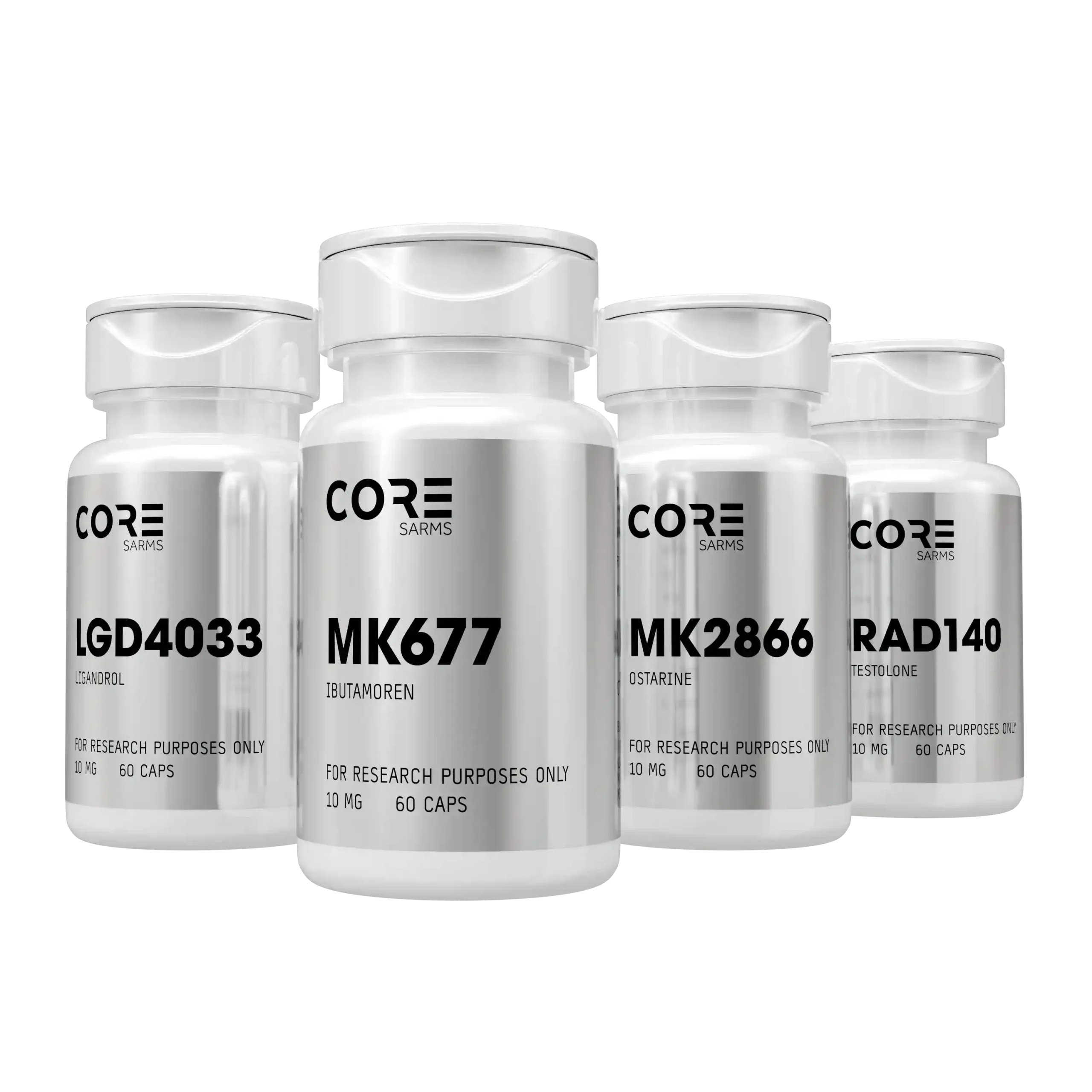
Muscle Building Bundle
Complete muscle building stack: Ligandrol, Testolone, Ostarine, Ibutamoren